UPDATE: New Brunswicker stopped, handcuffed at U.S. border for travelling with ‘too much clothes’
Saint John resident Angela Daigle says she was trying to cross into the U.S. to visit her fiancée when she was handcuffed and detained
Author of the article:Adam Huras
Published Aug 21, 2025 • Last updated 1 day ago • 5 minute read
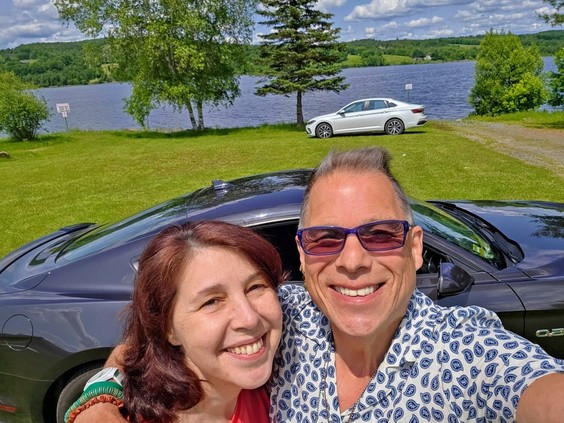
Saint John resident Angela Daigle says she was trying to cross into the United States to visit her fiancée, David Slagger, when she was handcuffed and detained for hours at the Houlton land border for allegedly travelling with "too much clothes." Submitted
Saint John resident Angela Daigle says she was trying to cross into the United States to visit her ailing fiancée (sic) when she was handcuffed and detained for hours at the Houlton land border for allegedly travelling with “too much clothes.”
That’s as U.S. Customs and Border Protection said in a statement on Friday they believe “Daigle was transporting personal belongings to the United States with the intent of permanently relocating.”
But her partner, David Slagger, a former member of the Maine House of Representatives representing the Maliseet Tribe, who is also a dual citizen and a Canadian Indian status card holder, believes it’s a case of profiling.
That’s as he says New Brunswick First Nations members are increasingly afraid to cross the border.
It’s a concern that Premier Susan Holt’s office says it has flagged with the federal government.
Slagger, who is Bangor-born and is a well-known member of the Houlton Band of Maliseet Indians as well as the Woodstock First Nation in New Brunswick, says he’s now selling his home in the lake community of Monson, Maine, denouncing his U.S. citizenship, and moving permanently to New Brunswick.
“I’m selling my house and I want to get the hell out of the United States even though I was born here,” Slagger said in an interview with Brunswick News.
“I’m afraid to live here.
“I feel like they’re targeting people like me.”
Slagger said he feels he’s faced discrimination at the border for years, but that it has escalated recently, stating that he was disrespected at the border in June, alleging U.S. border agents mistreated his feathers and confiscated a ceremonial drum he has used for decades, while also threatening to not let him back into the U.S.
That’s as Slagger is a disabled U.S. veteran who said he served in a combat unit.
He also was the first tribal representative in Maine’s Legislature and has retired from working as a teacher in the University of Maine System.
His fiancée, Daigle, a retired nurses aid from Saint John, had crossed over the border several times without incident, until last weekend.
In an interview, Daigle said she first attempted to enter the U.S. on Sunday at the Calais- St. Stephen border crossing, but that border agents did not believe that she was visiting, citing that her vehicle was filled with clothes.
Daigle said she had packed to take care of Slagger who was scheduled to have back surgery.
She insists that her trip was only going to be for two weeks.
“Ultimately, they felt like I had too many items, too much clothes, in my vehicle to cross for two weeks to visit my partner,” she said. “So my car was searched and I was detained.”
Daigle, who described herself as a quiet soft spoken person, said she was scared, confused, and nervous and that it led border guards to become angry, yelling at her.
Article content
“I felt really intimidated, I just didn’t understand why,” Daigle said.
She said she faced repeated questioning about who she was meeting up with and why, adding she believes, in hindsight, that profiling played a role.
“They were asking me all kinds of questions about my partner and I was being very honest and forthright and forthcoming in answering them,” Daigle said, who is not of Indigenous descent, but said she’s “troubled” that her fiancée’s race could be a factor.
“I was just scared because I didn’t know the process.
“They were making me feel like I was a criminal.”
Daigle was eventually finger printed, asked to sign a document, the details of which she still doesn’t know, and then was released back into New Brunswick.
Article content
The next day, after Slagger said he called U.S. Customs and Border Protection to receive assurances that his fiancée could cross, Daigle attempted to enter the United States through the Houlton-Woodstock crossing.
There, Daigle said she was asked to pull over again and was brought inside a customs office where she was eventually handcuffed to a bench for several hours.
“I didn’t know what was going on because it was a nightmare at Calais and here I am trying to go through again,” Daigle said. “I was upset and really scared.
“They said they just felt that I was going to run, but I was just really nervous. I was really upset and I was just crying the whole time.”
Daigle maintains she has no criminal history, never been arrested, and has never been stopped at the border before.
Article content
She described an integration that attempted to “threaten,” “antagonize,” and “fearmonger” her, while adding she has bruises on her arm from being grabbed by a female officer.
“It was terrible,” Daigle said.
“I never want to go near the border again.”
Daigle said that while traumatized by what took place, she felt it necessary to speak out to inform others.
“So maybe something, at least awareness, will be the positive note on this because it has affected my mental health,” she said.
U.S. Customs and Border Protection spokesperson Ryan Brissette told Brunswick News on Friday its officers “are dedicated to enforcing U.S. immigration laws fairly and impartially.”
“Angela Daigle was recently encountered by CBP at the Ports of Calais and Houlton, Maine, traveling alone,” Brissette said. “During a routine secondary inspection, it was determined that Ms. Daigle was transporting personal belongings to the United States with the intent of permanently relocating.
Article content
“CBP officers confirmed that Ms. Daigle is a Canadian citizen, not a U.S. citizen or Legal Permanent Resident, and does not qualify for North American Indian status. Additionally, she did not possess the required visa to establish a permanent residence in the United States.”
Brissette said Daigle was informed of the need to obtain the appropriate visa to immigrate to the United States.
“She was permitted to withdraw her application for admission to secure the necessary documentation. After CBP processing was completed, she was returned to Canada,” he added.
Slagger said he has since also written to Maine Sen. Susan Collins and Premier Holt, as well as Manitoba Premier Wab Kinew, Canada’s first provincial premier of First Nations descent, alerting them of the problems at the border.
Article content
Holt spokesperson Katie Beers told Brunswick News that the office had received a letter from Slagger and has since passed along concern to federal officials.
A spokesperson from Sen. Collins’ office, Blake Kernen, said on Friday that “Senator Collins’ staff has been in touch with CBP officials regarding this matter.”
Slagger said that word has circulated throughout the Woodstock and Tobique First Nations “to not go anywhere near the border because you’re not going to be safe,” citing Trump administration policy to restrict entry.
“I think it’s profiling,” he said. “I think they’re following their orange leader, his wishes, that target people.
“This is terrible that two innocent people get traumatized by U.S. Customs agents.”
Slagger said he now plans to move to the Woodstock First Nation to reunite with Daigle.
“I’ll never set foot in the United States again,” he said.
“It’s basic human dignity. I’m afraid to live in the United States, I never thought I would say that, but this is not freedom and democracy here.
“I just can’t wait to get what I need, get to New Brunswick, and never come back to the United States. I don’t want to be an American anymore, I don’t want to be associated with this country.”
https://tj.news/new-brunswick/new-bruns ... ch-clothes
DisruptSQ
MOD
•
3h ago
•
Stickied comment
Profile Badge for the Achievement Top 1% Poster Top 1% Poster
‘too much clothes’ was also the explanation given to the Australian woman (also trying to visit her (active duty) husband) [1] [2] [3] [4]
“They kept telling me that I had too many clothes in my suitcase. So because of that, they assumed that I was going to overstay my visa,” she said.
CharmingCrust
•
3h ago
Meanwhile US tourism organizations are scratching their heads not understanding why people won't visit. It is a conundrum with no apparent answers however the trend seems to continue. Confusing. Cause and Effect seem to be eluding the smartest people in the room. So far the only answer that is producing some results, is to provide more firearms to agents at the border. Evaluation of the new strategy is pending.